
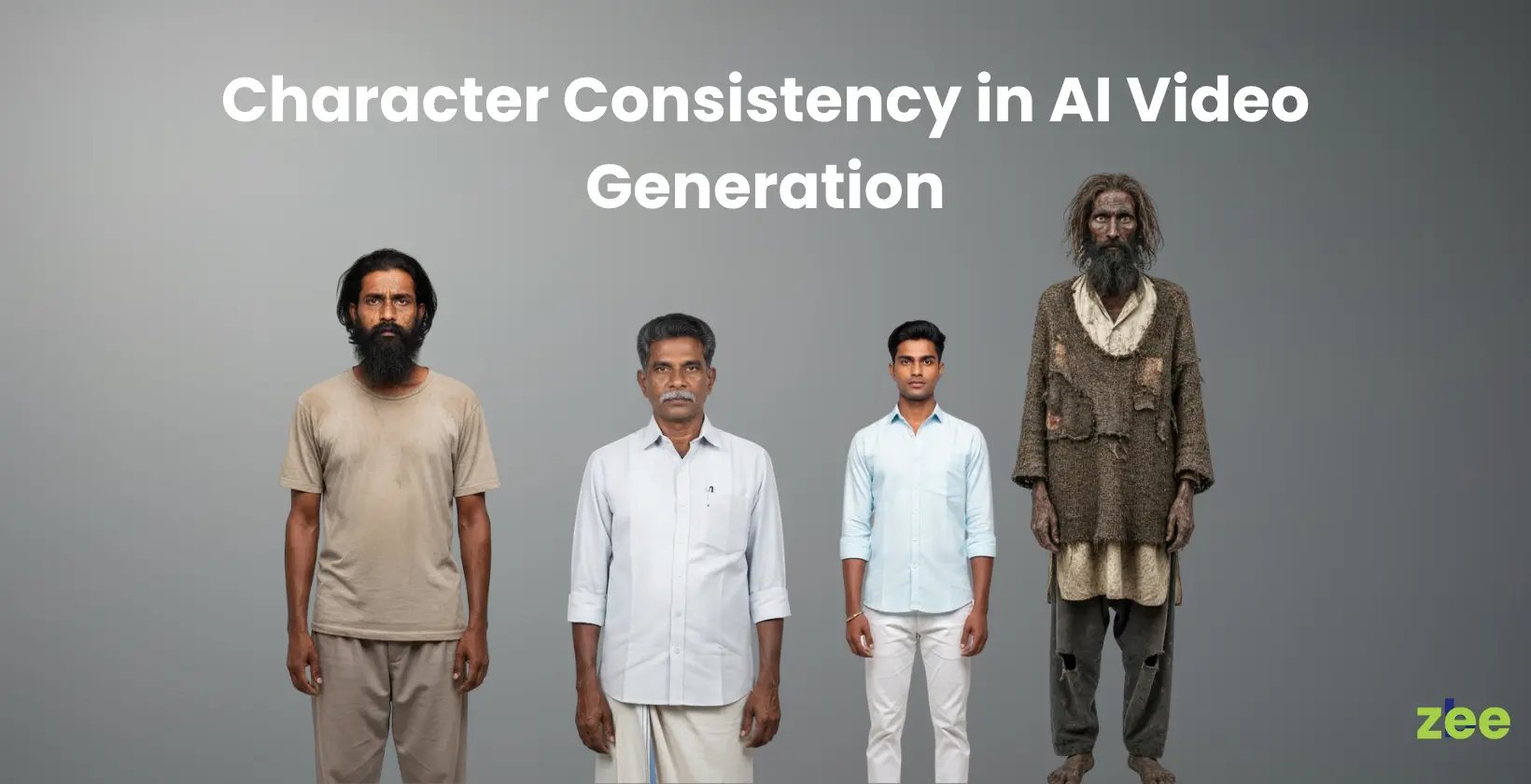
When AI-generated videos start looking impressive, the first technical weakness that usually appears is character inconsistency. A face changes slightly between scenes, clothing shifts without reason, age looks unstable, or expressions stop matching the same identity. For short experiments this may look minor, but in structured storytelling, educational video production, cinematic sequences, or branded visual systems, inconsistent characters immediately reduce credibility.
Character consistency is not only an image-generation issue. It is a continuity problem that begins before the first prompt is written. In practical production workflows, consistent results come from locking visual identity early, defining repeatable attributes clearly, and controlling how every scene references that same visual base. In client work, this becomes even more important because one unstable character can break an entire production sequence.
For AI video systems, consistency should be treated as a production framework rather than a prompt trick. Once the framework is stable, scene generation becomes faster, revisions become easier, and long-form outputs remain visually coherent.
Why Character Consistency Breaks in AI Generated Videos
Most inconsistency happens because prompts describe a scene but fail to preserve identity anchors. AI models respond strongly to immediate scene instructions, so when environment, mood, angle, or action changes, the model often reinterprets facial structure, body proportions, clothing texture, or age.
A character that appears stable in one portrait can drift in motion because the prompt gives too much freedom in later scenes. Hairline shifts, jawline changes, eye shape softens, or clothing fabric suddenly changes because those attributes were never locked as fixed production variables.
Another common issue is prompt rewriting without maintaining the same physical language. Small wording differences often create large visual differences.
The Role of Identity Anchors
Identity anchors are the permanent details that should never change unless the story intentionally requires change. These include:
- age
- face shape
- skin tone
- eye structure
- hair texture
- clothing base
- posture style
- emotional baseline
These details should stay identical across every scene prompt.
Why Scene Detail Alone Is Not Enough
Many creators focus heavily on scene atmosphere but forget identity continuity. A beautiful cinematic frame can still fail if the audience feels the character is visually different every few seconds.
Build a Character Bible Before Scene Generation
The most reliable way to maintain consistency is creating a character bible before production begins. This means writing one permanent visual profile that becomes the reference for every image and video instruction.
A proper character bible should describe the person the way a production team would define a lead actor.
What a Stable Character Profile Should Include
A practical profile normally includes:
- exact age range
- height and body build
- face geometry
- skin texture
- eye color and shape
- hair density and direction
- clothing material
- cultural styling
- default posture
Example of Production Logic
If a character is introduced as a middle-aged Pakistani man with slight beard density, olive skin tone, narrow eyes, charcoal grey kurta, and calm restrained posture, that exact combination should remain unchanged in every later scene unless the story explicitly changes time, outfit, or context.
This method reduces regeneration errors significantly because AI receives fixed visual memory through repeated structured description.
Use Prompt Repetition Strategically Instead of Prompt Variation
Many creators think variation improves realism, but for character stability repetition is often more powerful than creativity.
The strongest production method is repeating critical physical attributes in every scene prompt while changing only the scene-specific action.
For example, location, lighting, camera angle, and gesture may change, but identity description should remain stable.
Separate Permanent and Variable Prompt Layers
A simple production workflow uses two layers:
Permanent Layer
This contains identity that never changes.
Variable Layer
This contains scene action:
- sitting
- walking
- speaking
- turning
- holding object
This separation keeps prompts cleaner and improves output reliability.
Control Clothing Logic Carefully
Clothing inconsistency is one of the fastest visible errors in AI videos. Fabric type, color tone, sleeve structure, and wear pattern should remain fixed inside one sequence.
Even slight wording changes like “grey shirt” versus “dark charcoal kurta” can create unnecessary drift.
Maintain Continuity Across Camera Angles and Scene Expansion
Once scenes expand into multiple angles, continuity becomes harder because close-ups often exaggerate model drift.
Wide shots may preserve identity, while close-ups suddenly alter facial detail.
The practical solution is keeping the same facial description repeated even inside angle-level prompts.
If Scene A shows the character entering a room, then close-up prompts must still repeat the same locked face details rather than assuming AI remembers previous output.
This becomes essential in cinematic storytelling, educational explainers, and AI-generated narrative systems where one character appears repeatedly across many segments.
Where Character Consistency Connects with Professional AI Production
In larger content systems, character consistency is not isolated. It connects directly with scene planning, visual storytelling logic, script structure, and production hierarchy.
That is why strong workflows usually combine continuity planning with structured prompt systems rather than isolated generation experiments.
For businesses building AI content pipelines, educational channels, or visual storytelling assets, a stable production method saves large amounts of correction time and improves final output quality.
A structured approach becomes even stronger when visual generation is connected with AI video workflow design and content production systems that keep every output aligned across multiple formats.
For projects that require long-form visual consistency, many creators also combine this with cinematic storytelling frameworks so characters remain stable while scenes still feel dynamic and natural.
If you are building AI-generated educational content, cinematic storytelling, branded videos, or production systems that require long-term visual consistency, structured workflow matters more than isolated prompts.
Explore our professional solutions for AI content systems, visual workflows, and production strategy to build outputs that remain consistent across scenes, platforms, and formats.
For practical implementation and visual understanding, watch the complete video below.
Frequently Asked Questions
Character consistency means keeping the same facial identity, clothing, proportions, and visual personality stable across multiple scenes so the character looks recognizably identical throughout the video.
This usually happens when prompts change too much between scenes or when fixed identity details such as face structure, age, and clothing are not repeated clearly.
Yes, a character bible helps lock visual attributes early and gives every scene a stable reference, which improves continuity in both short and long-form production.
Yes, consistent characters make scenes feel connected, strengthen viewer trust, and help the overall story look more professional and believable.